

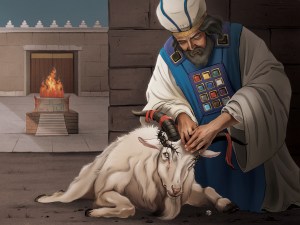
In the scapegoat sacrifice, the scapegoat is “blind” as to their fate.
Estimated reading time: 15 minutes
The Qualifications of the 144,000 to be a Scapegoat
The closing point of my last blog was: “The key to understanding God’s plan lies in knowing what He does during the Tribulation.” Since our goal is to understand God’s plan for the Jews, we must look for and decipher their role in the Tribulation.
And therein lies the conundrum. There is a very prominent place where the Jews appear in the book of Revelation, but no one seems to know what to do with it. Revelation 7, verses 4-8, talks about the mysterious appearance of 144,000 Jews—12,000 each from 12 tribes. Many scholars question if this is a real occurrence (or not), and others question if the numbers are just symbolic. Yet, if these 144,000 are not real, why are they again mentioned in Revelation 14, where John lists some very specific qualifications for their selection:
- They are celibate—never having had sex with any woman. Thus, we assume they are all men.
- They follow the Lamb (Jesus) wherever He goes. Something extraordinary must have happened to bring this about!
- They have been “purchased and redeemed from among men [of Israel] as the first fruits [sanctified and set apart for special service] for God and the Lamb.” (AMP Version). This is a critical distinction. These 144,000 have been specifically claimed by God (Jesus) for a “special service” for which they will be the “first fruits.” The question is: What special service have they been set aside for? Stay tuned.
- No lie was found in their mouth.
- They are “blameless (spotless, untainted, beyond reproach).” This characteristic is significant. How can an army of adults still be defined by this claim? The reason why this is important will become apparent soon.
Why would John call out 144,000 Jews in Chapter 7 and then give such specific qualifications in Chapter 14 if they were only symbolic? Look at the qualifications carefully: They are celibate, they have been “purchased and redeemed” and “sanctified and set apart for special service,” and they are “blameless (spotless, untainted, beyond reproach).” Does this sound like the requirements for a sacrifice? Yet, how could 144,000 adult men fulfill these requirements? Anyone who has lived for any length of time would quickly be disqualified. As I pondered this question, it occurred to me that the only way these 144,000 Jews could mysteriously appear and fulfill these qualifications would be if they were resurrected from the dead! That’s the only thing that makes sense when I read they were “purchased and redeemed from among men [of Israel].” These 144,000 must be men who previously lived and have now been raised “for special service.” Before we get into what that special service might be, ask yourself, is there a prophecy you can remember where there was a mass resurrection?
The Raising of the “Dry Bones”
In Ezekiel 37: 10-11 (NKJV), records a curious prophecy you might remember concerning the raising of “dry bones in the desert.”
10 So I prophesied as He (God) commanded me, and breath came into them, and they lived, and stood upon their feet, an exceedingly great army. 11 Then He said to me, “Son of man, these bones are the whole house of Israel. They indeed say, ‘Our bones are dry, our hope is lost, and we ourselves are cut off!’
Notice that “an exceedingly great army” is raised from “the whole house of Israel.” At the time Ezekiel wrote this, the raising of the whole house of Israel would have been a miracle in itself, as 10 of the 12 tribes of Israel were lost after the exile—the time in which Ezekiel lived. But what do the words “Our bones are dry, our hope is lost, and we ourselves are cut off!” mean? Let me propose something now that will make more sense later:
- Our bones are dry: We have been dead for a long time.
- Our hope is lost: We died not receiving what we had hoped for—a Messiah.
- We ourselves are cut off—from God: What would have caused this condition? Perhaps it is because they have blindly rejected the very Messiah they were waiting for during their lifetime.
Things get more interesting as we read on in verses 12-14:
12 So, prophesy and say to them, ‘This is what the Lord God (the Father) says: My people (the Jews), I will open your graves and cause you to come up out of your graves. Then I will bring you into the land of Israel. 13 My people (the Jews), you will know that I am the Lord (Jesus, the Messiah) when I open your graves and cause you to come up from them. 14 And I will put my Spirit inside you, and you will come to life. Then I will put you in your own land. And you will know that I, the Lord, have spoken and done it, says the Lord.’” Ezekiel 37: 12-14 NCV (Emphasis is mine)
In verse 12, it says that the “Lord God” (God, the Father) will open up their graves and cause them to “come up” (implying some type of resurrection). Then Ezekiel says that his people (the Jews) will know that “I am the Lord.” They already know who God is—so he can’t be referring to God, the Father (“Lord God”). Instead, he says this great army of Jews will know that “I am the Lord”—a clear reference to the Messiah, Jesus. This is the reason they were cut off.
The Catalytic Event
So, imagine this. It is the middle of the Tribulation. Things are starting to go south with the antichrist. At first, he may have seemed like a good guy to the Jews because he accomplished a miracle by getting the 3rd Jewish Temple to be rebuilt on its original site. The Dome of the Rock, probably the second most revered shrine among Muslims, currently occupies this site. It is purported to be the place where Muhammad rose on his white horse to ascend to heaven. Having it replaced with the Jewish Holy Temple would be nothing short of miraculous (If not a declaration of war)! Unfortunately, 3 ½ years after he pulls off this miracle, the antichrist decides to enter the Holy of Holies and declare himself to be god—not a god, the God! This is a catalytic event! Biblical scholars call this act “the Abomination of Desolation.” It is the highest insult one can make to God and His Chosen People, the Jews! This really would be a declaration of war! Things are going to get very uncomfortable on earth as God begins to unleash a series of punishments that would make the ones he did with Moses and the Egyptians look like child’s play. As a result of this insult, Jesus descends on the earth in His 2nd Coming to rapture up all Christians—past and present—to save them from the terrors that are soon to come. Yet, once all Christians are removed from the planet, who will be left to help save those who are left behind? (Yes, we cannot forget them even if they are most likely very vile and corrupt people!)
Raising up a Massive Scapegoat Offering
Enter Ezekiel’s prophecy. If “an exceedingly great army” is raised from “the whole house of Israel” “for (a) special service,” who would be better prepared than 144,000 “purchased and redeemed” Jews who want to defend the honor of their “Lord God” whose holy place has just been defiled? But imagine this: just as they are being raised from the dead, they see Jesus raising up all His Christian brothers and sisters in something called the Rapture. Instantly, they realize that the Messiah they spent their lives waiting for is Jesus! Joy fills their souls, but it is quickly followed by sadness for the rest of their people who also made the same mistake. Now, here lies a critical question. If these 144,000 have just been resurrected, seen Jesus, recognized Him, and accepted Him—are they now saved? I believe they are! For the first time in history, someone is saved for accepting Jesus after their death! But is that the special purpose for which they were selected? I would say—not entirely! To me, their “special service” calling is threefold:
- First, they are being called to avenge God, the Father, for the insult done by the antichrist.
- Second, they are being called to preach the Gospel message to all those remaining after the Rapture. After all, there are no Christians left, so without the 144,000, what hope would anyone have of finding redemption? All 144,000 will die in this effort (and many of whom they lead to Christ)! Listen as they plead for their deaths to be avenged (Revelation 6: 9-11 NCV):
9 When the Lamb opened the fifth seal, I saw under the altar the souls of those who had been killed because they were faithful to the word of God and to the message they had received. 10 These souls shouted in a loud voice, “Holy and true Lord, how long until you judge the people of the earth and punish them for killing us?” 11 Then each one of them was given a white robe and was told to wait a short time longer. There were still some of their fellow servants and brothers and sisters in the service of Christ who must be killed as they were. They had to wait until all of this was finished.
The message is that anyone who preaches the Gospel during this part of the Tribulation will be killed. But the ones crying out seem to be part of the 144,000 since (at this time) not all of their fellow servants have been killed. The reference to “and brothers and sisters” probably means anyone who accepted Christ during this time as a result of the preaching of the 144,000.
- Third, they are being offered as a scapegoat offering for their people so they too can be saved with them. I believe that Jesus intends to use the 144,000 to not only save themselves but also to save all the Jews who were blinded from seeing Him during their lifetime (The Blind Remnant). But how will Jesus accomplish this miracle?
Now, if this were a movie, we’d have a big drumroll before revealing what (I believe) Jesus has in mind. He knows that unless something spectacular is done, all those who rejected Him during their lifetime are not going to heaven. Imagine how desperately the 144,000 want to atone for their brothers and sisters who died without accepting Jesus as their Savior, Messiah, and Lord? As soon as that thought crosses their minds, imagine again that they hear the voice of Jesus saying, “Fear not, my brothers! I know your sorrow! Today, I am laying my hands on your heads and praying the sins of your countrymen onto you. Go now into the wilderness below and present yourselves as an offering for your people so you can redeem them from their sin of rejecting me.” But what would Jesus mean by saying, “I am laying my hands on your heads and praying the sins of your countrymen onto you.” What does Jesus have in store for them?
I believe the answer to that question can be found in Leviticus 16, where we learn about the Jewish Law of the scapegoat. Here’s what one commentator has to say about this Jewish practice:
There is a strong ritualistic element to the scapegoating: Aaron (as High Priest) will confess all of the sins of the Israelites while placing his hands on the animal’s head, as if imparting the sins into the goat’s body. This is because the scapegoat ritual is part of the Day of Atonement, also known as Yom Kippur: one of the holiest festivals in Judaism. ((Oliver Tearle, “A Summary and Analysis of the Biblical Scapegoat Story,” Interesting Literature, https://interestingliterature.com/2021/10/bible-scapegoat-story-summary-analysis-origin/.))
 |
 |
This is how the law worked: One goat was chosen by lot to be sacrificed as a sin offering. After the first goat was sacrificed, the High Priest would place his hands on the head of the scapegoat and pray all the sins of the people into him. The goat would then be released into the wilderness, where (symbolically) it would carry away all Israel’s sins, and the scapegoat would then die in the wilderness. Thus, the scapegoat is the one who makes atonement (or redeems) by carrying all the sins of the people away. It is important to note that this is the only sacrifice made by the Jews (in any ceremony) for which all of their sins were attoned for in one sacrifice! This is how it was described in Leviticus:
When he has finished atoning for the Holy Place and the Tent of Meeting and the altar, he shall present the live goat. Then Aaron shall lay both of his hands on the head of the live goat, and confess over it all the wickedness of the sons of Israel and all their transgressions in regard to all their sins; and he shall lay them on the head of the goat [the scapegoat, the sin-bearer], and send it away into the wilderness. (Leviticus 16:20–21, AMP)
This is how I believe God will account for all the sins of any Jew who rejected Jesus during their lifetime due to a blindness that was placed upon them to accomplish God’s purpose.
Biblical Precedences for a Scapegoat Offering
There are three times in the Bible where certain variations of the scapegoat offering took place:
- Once, with Abraham, where a scapegoat was found to replace Isaac as an offering to the Lord.
- Once, with Jesus, where Jesus was the scapegoat who took on all the sins of the world for His people.
- And, if I am correct, once with these 144,000 Jews who will take on the sins of their people and allow them to save the Blind Remnant so they can gain entrance into heaven.
An interesting twist occurred with Abraham. In his case, a “male sheep” or lamb was found and sacrificed, not a goat. I find this significant symbolically, as it suggests that Jesus, the Lamb of God, redeemed Isaac as both a sin offering and a scapegoat offering, thus making Abraham’s line (through Isaac) acceptable to God.
Justification for the 144,000 Sacrifice
Now, notice how this sacrifice works for the 144,000:
- The 144,000 are described as “blameless (spotless, untainted, beyond reproach).” Isn’t this the very definition of the qualification of a sacrifice under Jewish law?
- But then you might say, where is the sin offering? Revelation makes it clear that “These are the people who have come out of the great distress. They have washed their robes and made them white in the blood of the Lamb.” There is great significance in this verse. First, it appears clear that Jesus is the sin offering for the 144,000 just as He was for Abraham. Below, we will learn about the symbolism of turning the robes white.
- Then, once the 144,000 recognize Jesus as their Messiah and Lord, I believe that Jesus, in His role as a High Priest (See Hebrews 9), will pray over their heads and place the sins of all those who rejected Him onto the 144,000. He will then send them into the wilderness of the antichrist, where they will sacrifice themselves as a scapegoat to redeem all their people who rejected Jesus (and to avenge the insult to their Father committed by the antichrist). I believe that this is why the tribe of Levi is included in the 144,000—to emphasize the holy, priestly role they have been called to perform.
- Once the sacrifice is complete, its acceptance is confirmed when Jesus’ blood is applied (by the washing their robes—they “washed their robes and made them white in the blood of the Lamb.”) It is interesting to note that originally when the scapegoat was released, a crimson (red) thread was wrapped around his horns. Another red thread was strung across the entrance to the Temple. Tradition states that if the thread hung across the entrance to the Temple turned white, that represented that God had accepted their sacrifice and they were now “washed clean.” Do you see how this tradition lines up with the words in Revelation, where the robes of the 144,000 were washed in Jesus’ blood and made white (clean)? ((Another twist to the crimson thread story is this: After Jesus died, Yom Kippur was celebrated for another forty years until the Temple was torn down by the Romans. Tradition states that for each one of those forty years, the crimson thread never turned white! The Christian Jews interpreted this as a symbol that Christ’s sacrifice wiped away their sins forever, so no more sacrifices were necessary. But the traditional Jews took an opposing view, surmising that the thread failed to turn white because of the sin of those Jews who choose to follow a false messiah.)) I believe that this symbolizes that the Blind Jewish Remnant has been accepted by Jesus and redeemed—once and for all time.
Conclusion
So, what is your take on my interpretation of God’s plan for the Jews? Have I stretched things a bit too much for you? If so, allow me to share one final piece of evidence. In Revelation 15: 2-3 NCV, John writes:
2 I saw what looked like a sea of glass mixed with fire. All of those who had won the victory over the beast and his idol and over the number of his name were standing by the sea of glass. They had harps that God had given them. 3 They sang the song of Moses, the servant of God, and the song of the Lamb. (NCV)
This is the end of the Tribulation. God’s people and His angels have “won the victory over the beast and his idol and over the number of his name” and are celebrating in heaven. Yet, who do you think these victorious people are with them? They are singing the Song of Moses! Who else besides the Jews would find such meaning, emotion, and symbolism in singing Moses’ song after battling and defeating Satan? This is the same song all the Israelites sang with Moses after their victory over Pharaoh and their exodus from Egypt (see Exodus 15). One job was completed when Pharaoh was defeated, and the final job will be completed when Satan is defeated! Each time, the Jews celebrate by singing the Song of Moses—with God and His angels! What a moment that will be!
Equally amazing is they sing the Song of the Lamb. The symbolism of this moment cannot be lost. The Jews are in heaven at the end of the Tribulation, acknowledging Jesus as the Lamb of God in a victory song sung upon the defeat of Satan.
These are the reasons why I truly believe that neither Jesus nor God the Father will fail to do all that they can to redeem their chosen people, especially the Blind Remnant. The blindness that kept them from recognizing and accepting Jesus was brought on them for a purpose—to redeem the whole world! And that, my friends, is something to reward, not punish.
Like what you read? Don’t miss the next edition! Subscribe to my posts.

One Comment