
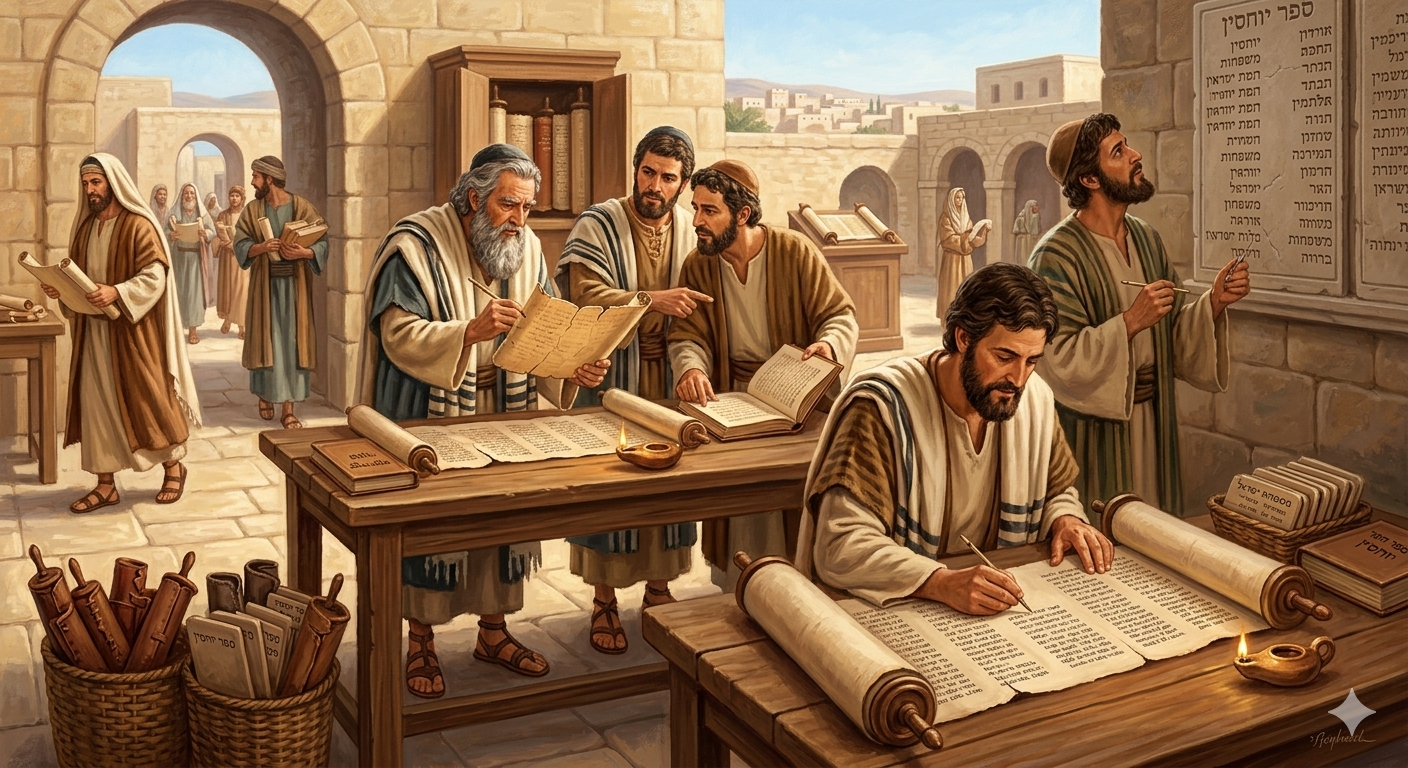
The Jews have always been deeply concerned about tracing their roots!
An Unlikely Gospel
The book of Matthew was, from the very beginning, the undisputed favorite book of the early Christian church! So, it comes as no surprise that it was chosen to be the first book in the New Testament. Yet, how was this possible? Matthew was probably the least liked of all Jesus’ disciples. He was a tax collector when Jesus called him. And the scriptures confirm that Jesus’ choice did not impress the Pharisees and was probably a bit suspect even among his disciples. The Jews hated tax collectors because they were puppets of the Roman Guard. They often cheated the people, and, as a result, they lived in luxury while their people struggled. Even the Romans hated tax collectors. They were a necessary evil, chosen from among the people they ruled over, but the most effective were also the least trustworthy.
So how did this “scum of the earth” tax collector become so popular in the early Christian church? Well, in addition to being a confirmed disciple of Jesus and a direct eyewitness to His life, Matthew saw things from a Jewish perspective because he was a Jew. As a result, he focused his Gospel, as of first importance, on appealing to the needs of the Jews. Matthew is generally considered the first to write down his observations (not surprising for someone whose prior profession was all about writing things down). And, historical records show that Matthew was the most widely copied, quoted, and read Gospel in the 2nd and 3rd centuries! Why? Because, in appealing to the needs of the first-century Jewish Christian, his Gospel was considered a crucial link between ancient Jewish scripture (the Old Testament) and Christianity (the New Testament). It explicitly quotes Old Testament prophecies dozens of times to prove Jesus was the Messiah. As a Jew, Matthew must have felt the weight of his obligation to “bridge the gap” between old Jewish traditions and the new covenant under Jesus. And, Matthew knew his audience would be particularly critical of how he established Jesus’ genealogical credentials, since any good Jew knew the Messiah would come from King David’s line.
A Jewish Prerequisite
So, Matthew begins his Gospel with his trump card – the genealogy of Jesus. Now, if you aren’t a Jew, this decision will be lost on you. But the very first thing a Jew wants to know about you is where you came from. And if Matthew were going to claim that Jesus was the Messiah, His genealogy would be critical. Jews were fanatical about genealogy long before it became popular through DNA testing and tracing. The typical Jew could trace their family lines all the way back to Adam and Eve – with certainty! And they were very good about recording every word God spoke through the prophets because their words often gave clues about how God would use various lines of Jewish succession in the future. In fact, when Jesus was born, many Jewish scholars (who had studied these prophecies) felt that Daniel had predicted the Messiah would come around the time of Jesus. That, in combination with several other prophecies, led Matthew to begin his Gospel with a recitation of Jesus’ heritage. Doing so established Jesus’ legal claim to the throne of David, satisfying one key prophecy out of Samuel that predicted the Messiah would be a descendant of King David (2 Samuel 7:12-13 ESV: 12 When your (King David’s) days are fulfilled and you lie down with your fathers, I will raise up your offspring after you, who shall come from your body, and I will establish his kingdom. 13 He shall build a house for my name, and I will establish the throne of his kingdom forever.) According to Jewish tradition, Jesus’ legal claim to David’s throne was traced through the male descendants of King David. That is exactly what Matthew did to cement Jesus’ rightful place as the Messiah.
But a problem was looming in Matthew’s presentation. Joseph was not the biological father of Jesus (God was), so Jesus could not “come from your (King David’s) body.” He did legally adopt Jesus, so technically, the line was not broken, but for some, this break was reason enough to question what the prophets meant and thus, question Jesus’ claim to be the Messiah. After all, many saw the Messiah coming as a conquering king, just like David, and Jesus was clearly not that. Fortunately, we have the Gospel of Luke to help us deal with this and other issues.
The Greek Perspective
Luke provides us with the perspective of a Greek Gentile. He was not an eyewitness to Jesus’ life, but he was a faithful follower of the Apostle Paul and accompanied him on many of his journeys. We are also told (in Colossians 4:14) that Luke was a physician. His writing reflects a certain level of polish and attention to detail not found in the other Gospels. Luke is also credited with having written the book of Acts, so his combined contribution to the New Testament is substantial. But it is not his contributions I want to focus on. As with everything God does, there is a specific reason why Luke wrote one of the Gospels. As a Greek, Luke brought a perspective that was absolutely critical to understanding who Jesus was. As a Greek, Luke was free to look at Jesus without the clutter of Jewish traditions. As a Greek, Luke came from a background where women were more highly respected than they were by the Jews (after all, the Greeks worshipped both male and female gods!) As a result, Luke reports on the women in Jesus’ ministry far more than any other Gospel writer. And that, my friend, is significant. God chose Luke for a reason. For without Luke, we may not have seen Jesus’ biological claim to the throne of David – a claim that provides Jesus with an unbroken line to fulfilling the prophecy of Samuel. None of it would have been possible without Luke’s perspective on women.
Two Very Different Viewpoints
For the casual reader, you may read Matthew and Luke without really noticing (or caring) that both provide a genealogical record of Jesus’ family. “OK, so He is connected to King David, and that is supposed to matter. What’s the point?” Well, some scholars would agree with you, at least to the point of saying that both genealogies belong to Joseph. After all, what are the odds that both Joseph and Mary would be descended from King David? Yet, if you take a closer look, Matthew traces Jesus’ lineage through King Solomon to his father, David, whereas Luke traces a line that goes through another son of King David, Nathan. Clearly, they cannot be identical lines! And Luke was too smart to make that kind of error! So, which line did Luke report and why?
By now, I think the answer should be obvious. Matthew reported Jesus’ genealogy in accordance with Jewish protocol, tracing the line through Joseph to King David. We know that Joseph was from the line of King David, because, in Luke 2:4 (ESV), it says: “And Joseph also went up from Galilee, from the town of Nazareth, to Judea, to the city of David, which is called Bethlehem, because he was of the house and lineage of David.” But Luke must have been very aware of Matthew’s Gospel, as many date it as early as 50 AD, and (as we’ve already pointed out), it was very popular. It is believed that Luke wrote his gospel and the book of Acts between 60 and 80 AD. Being the scholar he was, Luke decided to take a different approach (because, as we shall see, he spotted a significant loophole). He was not confined to Jewish customs, and he knew tracing Jesus’ claim to David’s throne was an important detail. So, it makes sense (as a Greek) that he would choose to trace Jesus’ lineage through Mary since only she could provide an unbroken biological link to King David and thus fulfill certain important prophecies. Think of it this way: Matthew’s list becomes a list of fathers (according to Jewish tradition), whereas Luke’s list becomes a list of sons (i.e., Jesus was the son of Mary, etc.).
The significance of providing a list of sons becomes clear when you see that Luke carries Jesus’ genealogy all the way to Adam – the original “son of God” (at least according to Genesis). But we know that Jesus was actually the only true Son of God because He is God, and Adam was not a god (only created in God’s image). Nonetheless, Jesus is often referred to as the “New Adam” or the “Second Adam” because the first Adam failed his test of obeying God – Jesus did not. By taking the route of providing Mary’s lineage, Luke sews up any biological loopholes left by Matthew. And, as I said before, what are the odds that Joseph and Mary would bring such a powerful 1-2 punch to proving Jesus’ claim to David’s throne?
Now, some of you may respond, “So what! Why does this matter?” Maybe it isn’t a huge point. But, if you are accepting Jesus as your Lord and Savior – the one and only person who can keep you out of hell and deliver you from death into eternal life in heaven, how certain do you want to be? The Bible provides us with unparalleled detail about who we are placing our faith in. I, for one, love discovering just how much God has done to provide us with such certainty behind our decision. Praise be to God, and our Savior, Jesus Christ!
Like what you read? Don’t miss the next edition! Subscribe to my posts.[/vc_column_text][/vc_column][/vc_row]
Extra Credit Section for Bible Nerds
Although I have wrapped up the key points I wanted to cover, there are still a few loose ends some might accuse me of having conveniently skipped. However, if you know me, I am aware of most of the loose ends in this tale, and I have considered them in my story. I just spared most readers from having to deal with them. If you are reading this, I hope it is because you love loose ends as much as I do!
As I said before, there are two theories about the genealogies given by Matthew and Luke: one says they both trace Jesus through Joseph, and the other (my preference) says that Luke traces Jesus through Mary. But, if you want to know, here’s what I skipped:
- Who was “Heli?:” In Matthew, Joseph is listed as the son of Jacob, and in Luke, he is listed as the son of Heli (Eli). Since the Virgin Birth meant Jesus had no biological link to Joseph, some believe that Luke was following the “seed of the woman” (Mary’s line). But others claim that Luke felt compelled to conform to Jewish traditions, so he simply offered a different account of Joseph’s line. There are (at least two problems with that approach):
-
- As I mentioned before, Luke was a Greek, not a Jew. Why would he feel so compelled?
- If Luke did feel compelled, his commitment was weak. Jews always traced genealogies down by starting with the ancestor they wanted to emphasize (in Matthew’s case, Abraham – verse 2). But Luke traced the genealogy up, starting with Jesus and working his way to Adam. Very non-Jewish!
So who is Heli (Eli)? Herein lies the crux of the problem. We have all these prophecies talking about Jesus descending from King David, yet we have only two places in the Bible where Jesus’ lineage is mentioned. And, if they are both from Joseph, then we have zero biological link to King David because there is no other place in the entire Bible where Mary’s lineage is provided. So, either Jacob (in Matthew) is the father of Joseph, or Heli (in Luke) is. If Heli is Mary’s father, then he is also Joseph’s father-in-law. The Amplified Bible (AMP) paraphrase of Luke 3:23 is a modern version that reconciles the two genealogies by explicitly inserting the phrase “son [by marriage] of Eli.” [1],[2] This specific reading strongly supports the popular theory that Luke recorded Mary’s biological lineage, which many scholars and theologians argue was necessary to fulfill messianic prophecies. [3], [4] Since Mary’s lineage is not recorded anywhere else in the Bible, if Luke’s rendition is not Mary’s, a critical prophetic link is missing! This is what I mean when I say Luke spotted a critical loophole (a missing link) in Matthew’s proof that Jesus is the Messiah.
A final line of evidence is that every name in the Greek text of Luke’s genealogy is preceded by the definite article “the” (e.g., ‘the’ Heli, ‘the’ Matthat), with the one exception of Joseph. Although not obvious in an English translation, this would strike anyone reading the Greek, who would realize it traced the line of Joseph’s wife (Mary), even though Joseph’s name was used. Regardless, those who prefer to think that Luke (a Greek) would follow Jewish protocol just to please the Jews, probably will not be persuaded that Luke’s genealogy is that of Mary and Heli is her father.
- The Blood Curse of Jeconiah: Matthew’s genealogy traces Jesus’ line through Jeconiah (Matthew 1:11). Many see this as a problem because, in Jeremiah 22:30 (EASY), God cursed Jeconiah’s line, stating that none of his descendants would sit on David’s throne.
28This man Jeconiah will be like a broken pot. It is a clay pot that nobody wants anymore…30 The Lord says, ‘Write this man’s name on the list. Write it as the name of a man who has no children… None of his sons will rule as a descendant of King David. None of them will be king of Judah.’
Can you see the problem? Matthew’s list goes through the line of Jeconiah – someone specifically excluded by God to have a “son (who) will rule as a descendant of King David.” Thus, according to this prophecy, Joseph does not qualify for the line of the Messiah. If Luke provides a separate biological line (through David’s son Nathan rather than Solomon), it allows Jesus to be a biological descendant of David while bypassing the blood curse on Jeconiah.
- The Biological Argument: We have talked about this a lot, but it bears repeating. If you choose that both genealogies are of Joseph, then you negate any possibility of a biological connection to King David, because we all know that Joseph did not contribute any DNA to Jesus. This is a huge problem because certain prophecies insist that there must be a biological connection between the Messiah and King David. Remember the prophecy of 2 Samuel 7:12-13 ESV?
12 When your (King David’s) days are fulfilled and you lie down with your fathers, I will raise up your offspring after you, who shall come from your body, and I will establish his kingdom. 13 He shall build a house for my name, and I will establish the throne of his kingdom forever.)
Then, in Acts 2:30 KJV, Peter quotes a promise to David that God would raise up a descendant from the “fruit of his loins, according to the flesh.“ Paul states in Romans 1:3 KJV that Jesus was “made of the seed of David according to the flesh.“ Since the Virgin Birth (Luke 1:34-35) precludes a biological link through Joseph, these “according to the flesh” prophecies are often viewed as requiring a biological link through Mary. But, if we have no record of Mary’s lineage, how can we do that? God doesn’t leave loose ends! Thus, we have another reason to believe that Matthew’s lineage traces the royal line through Solomon, while Luke’s lineage must trace Mary’s natural, biological line through Nathan.
- The Genealogical Intersection: Two names appear in both genealogies – Shealtiel and Zerubbabel, so many use that as proof that the lines are the same. However, that argument doesn’t hold much weight if you do the math. Those names were very common at the time, and in Matthew’s list, they are marked as generations 15 & 16. In contrast, in Luke’s list, they are marked as generations 21 & 22 – clearly indicating that they cannot possibly be the same people, therefore not of the same genealogical line.
These are the more popular arguments for believing that the genealogies in both Matthew and Luke belong to Joseph. I think that, when all arguments are considered, we have no choice but to believe that Luke felt strongly that Matthew’s Gospel was missing one vital element – the genealogy of Mary. Without it, Jesus’ claim to being the Messiah is severely weakened.
[1] https://www.facebook.com/groups/550869485647170/posts/1833565410710898/?checkpoint_src=any
[2] https://www.facebook.com/groups/392842553254582/posts/628071003065068/
[3] https://noelinuae.medium.com/the-two-genealogies-of-jesus-christ-matthew-vs-luke-explained-9105001adc97
[4] https://www.themoorings.org/Jesus/Messianic_prophecy/lineage/texts.html
