
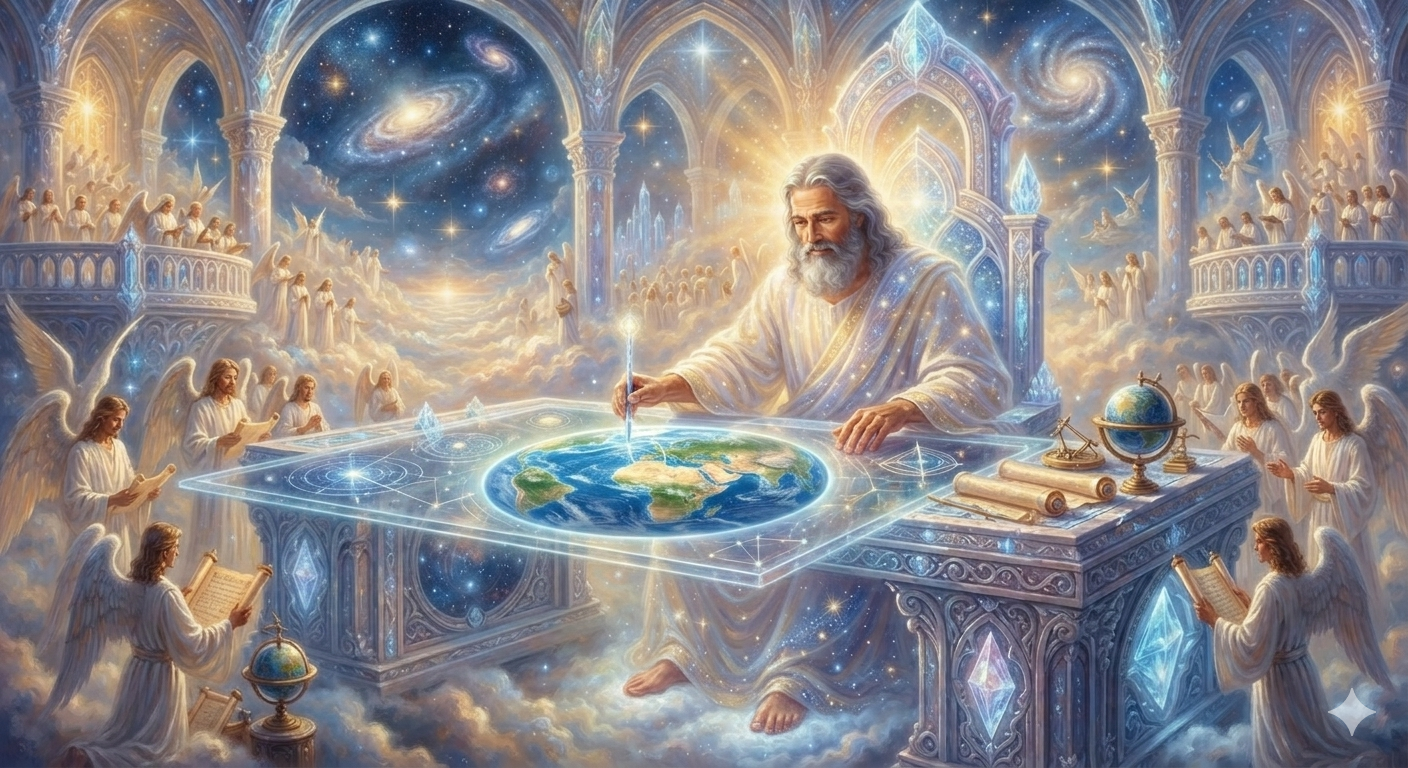
God is always working on plans that will bring us “hope and a good future.”
If you would like to listen to my blog instead of reading it, you can press the “Read Aloud” button above and have an AI bot read to you, or you can press the play button below and have me read it to you:
This blog is the first in a 3-part series that covers the main points of my book, God (Still) has BIG Plans for the Jews. Some might think that I’ve covered this subject before, and to you I’ll confess: “You’re right!” But, in my defense, as time passes, God gives me deeper insight into how He plans to save His people. In this approach, I want to try and cover the subject in what might be taught in three short lessons. Along the way, I will reference previous blogs that treat some of the more complex ideas in greater detail. That way, if someone wants to explore more or dig deeper, they can.
What’s in a Religion?
I’ve been a Christian for over 60 years! Some might think that I’m a Christian because I’ve just grown into a comfortable habit that I don’t question anymore. Others may conclude that I just haven’t considered any of the other alternatives. And still others may feel that I’m just a natural consequence of having grown up in a Christian home, sheltered by a Christian community, and protected by a country that (at the time) was considered a Christian nation. All somewhat reasonable assumptions, except for the fact that my nature is that of a scientist – I question everything, explore all options, test every assumption, and form my conclusions based on the facts. And in this day and age, when no one seems to care about “facts,” I’d suggest their lack of concern will eventually kill them! Why? Because, when choosing a religion, a wrong choice may literally kill you. Allow me to share with you just one of the facts that led me to determine that the Christian faith was the only true faith.
When examining a religion, I believe the first question you must ask is: How did this religion come into being? And, not surprisingly, almost all religions were founded by someone who either (a) had an idea for something better, or (b) felt that some “god” or “angel” or “vision” spoke to them and laid out a path which they then wrote down. Makes sense. But is that enough? Do you want to risk your eternity on the opinion/vision of one person? After all, the foundation of most religions is the acknowledgment that, when we die, there is a place we all go, and there may be a requirement to get in. That requirement is presumably set by a god or the God who determines our ultimate fate. So, let me ask my question again in a different way: Do you want to base your next life (if there is one) on the vision of a single person? I don’t. And here’s where the Christian faith starts to look a lot different from all the other religions.
A Miraculous Book
Our “manual” is very different from whatever manual guides all other religions. It was written over a span of 1,500 years, at a time when there were no printing presses, internet, or global means of communication – so each author generally had little or no sense of what was written before them.[1] It was written by 40 very different people from widely different backgrounds, education levels, and social positions. Yet these people wrote 66 “books” that, when assembled, contain a cohesive, intelligent, and amazing story of a God who first created everything inert, and then created life – people “in His image” along with a myriad of other creatures. This God then set “His people” on a path to ultimately understand who He was and how to worship Him. The key word there is “ultimately,” because the story this book tells spans thousands of years. No other religious book even tries to do such a thing (how could they, unless God were orchestrating it?). And, if you examine this book closely, you will be shocked at what it contains. If a human were to write a book telling you why you should believe in, respect, and honor God, that book would not contain the ugly details this one does. This book talks about murder, deceit, jealousy, war, the killing of women and children, and the worship of idols. And many of these actions are ordered by the God that is claimed to be, at the same time, both “loving and holy.” As a result, many who’ve only taken a superficial look have judged that they have no use for such a god. That would be a huge mistake. Think about this for a moment. We’re talking about a god that can create stars and planets that extend (even today) beyond our ability to imagine. And then this god can also create life in all the wonderful diversity we see on this planet. Do you think it is possible to fully comprehend how such a god would think? Yet, our Christian manual, the Bible, gives us an inkling if we just take the time to study what it says. If it took 1,500 years to write, I probably won’t ever understand all its nuances in my brief life. But after 60 years of study, God has shown me some of His amazing thoughts. Now, don’t get me wrong here. I’m not pretending to be any better than anyone else. My point is, God is a bit like a diamond, only this diamond has an infinite number of facets. You could spend a lifetime just trying to see and understand one of them. What I’m going to share with you over the next few blogs is my vision of a particular facet of God that has been shown to me. Others see different facets. Together, our job is to share and sort out how all these facets come together so we can have a prayer of seeing and partially understanding this God more clearly. It’s much like the tale of three blind men feeling out an elephant and then comparing notes. Each got a totally different impression of what an elephant is, yet their understanding was greatly expanded once they compared notes. But in understanding God, there is one critical rule we must follow: Each facet can only be seen through the lens of the Bible. If it doesn’t fit with what is in the Bible, then the facet you’re looking at is probably not a diamond, but (at best) zirconium. Any book that took >1,500 years to write is, at the very least, special, and, if we’re honest, only God could have written it.
Have we lost our focus?
Now, I believe we’re ready to focus on the facet God has revealed to me. For most of my Christian life, I did not realize how my view of Christianity had narrowed over the years. When I was a kid, my Sunday School teachers taught us stories about Joseph and his coat of many colors, about Moses leading the Israelites out of Egypt, and about David slaying Goliath. They were fun stories to study, and they made the Bible more interesting. But as I grew in my faith, I left those stories and focused more on understanding Jesus as the center point of my faith (and the Bible). What was wrong with that? What I didn’t realize was that as I grew closer to Jesus, two-thirds of the Bible became less and less relevant to me. It was a slow and subtle shift, but little did I know it was affecting my view of Christianity.
Let me be clear. I still felt that Old Testament prophecy was critical to understanding God’s plan, and I knew that God had not rejected His chosen people, the Jews. But I could not understand how (or if) God was going to save the Jews who rejected Jesus. What started as a religion that embraced two cultures gradually drifted apart and came to include only one. By 325 CE, at the Council of Nicaea, Judaism and Christianity officially separated into two distinct religions. But, and here is a most interesting fact: Both the Jews and the Christians are the only two religions in the world that use the same manual to study their God – the only difference is – the Christian manual has many more chapters! I find it interesting that the movement started by Jesus (who was a Jew) and his twelve Jewish disciples took almost 300 years to have the Jews abandon Christianity and revert back to the teachings of Moses (the first five books of the Bible). So, what happened? Some Bible “scholars” would like us to believe that this is all a natural result of the Jews rejecting God one time too many. Supposedly, when the Jews rejected Jesus and called for His crucifixion, God said, “Enough!” and washed His hands of them. And, if you have studied the Old Testament, you might just buy that theory because God regularly called them a “stiff-necked people”[2] who were constantly rebelling against God, the Father of Jesus. Even though the Old Testament does give us many passages where God makes it clear that “the Lord had not said that he would blot out the name of Israel from under heaven…” (2 Kings 14: 27 ESV), it is hard not to identify with His frustration over the Jews. As a student of Scripture, by the time I reached 30, I had lost my vision for what to make of the Jews. They were no longer “interesting”; they had left that status and moved over into a very questionable position.
So, without realizing it, I gradually bought into the concept that Christianity was no longer about the Jews; it was about bringing all the people of the world into a faith in Jesus. The Jews were just another target on our list of converts.
Like what you read? Don’t miss the next edition! Subscribe to my posts.
This is the first of a three-part series presenting the central message of my book, God (still) has BIG plans for the Jews!
Continue to Part 2: An Amazing Story—What Went Wrong?
[1] Before you argue with me on this point, let me explain. Although many of the authors of the Bible may have known about what was written before them, it was not to the depth nor extent that we have today. Much of what the early writers had was little more that word-of-mouth tales passed on by previous generations. Others may have had one or two manuscripts, but probably not much more.
[2] Exodus 32:9, Exodus 33:3, Deuteronomy 9, and Acts 7:51.
