

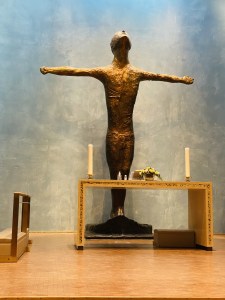
In this depiction of Jesus, He is free from the cross and is looking to heaven for His hope
Estimated reading time: 10 minutes
Do we really understand what Jesus did?
All Christians understand the concept of Jesus sacrificing himself for our sins. The Bible teaches us why when it says, “But God demonstrates his own love for us in this: While we were still sinners, Christ died for us.” (Romans 5:8 NIV) And the reason we’re told why Jesus’ death was necessary was because God demanded a perfect sacrifice – one that would erase all the sins of humankind forever. But do you know on what basis God prepared Jesus’ life to accomplish this purpose? You may think this to be a “so what” question, but God always acts within guidelines that define Him and preserve His holiness. I find it fascinating to know what God had in mind “behind the scenes” to accomplish His objectives.
As we know, God has interwoven thousands of years of tradition, images, and meaning into the story of Jesus. Unfortunately, we often miss all the “prep work” God did because the story by itself is so simple and compelling. Clearly, Jesus knew what he was doing and what the Father was expecting of Him. But do you? Is it possible there is more to Jesus’ sacrifice than you know?
The Universality of Jesus’ Sacrifice
The question I’m proposing is: How could the sacrifice of one cover the sins of everyone (past, present, and future) who believes in and accepts Jesus? For some, it is enough to know that Jesus said it, and thus it is so. Yet, knowing God’s thinking and purpose behind an act often helps us to understand other truths behind what He does.
Such is the case with Jesus’ sacrifice. What He did on the cross has so many messages and lessons that we must not miss the full extent of what he did.
- Breaking the “curse” of the Law: Jesus accepted the penalty of an Old Testament curse when He died “hanging on a tree.” In Deuteronomy 21:23 (NCV), it says that “because anyone whose body is displayed on a tree is cursed by God.” (some translations say, “a pole.”) Paul attributed the curse as relating to what the Law had done to his people. In Galatians 3:13 (NCV), “13 Christ took away the curse the law put on us. He changed places with us and put himself under that curse. It is written in the Scriptures, “Anyone whose body is displayed on a tree is cursed.” This was a major goal of Jesus’ life – to remove the curse (obligation) the Law placed on the Jews by requiring them to be something they could not be – perfect. God had asked them to “be holy, as I am holy” but the curse of sin was too much of a burden. The Law provided the guide on how to please God, yet anyone who failed was a sinner. Thus, the guidebook asked too much, and all who tried to follow it failed. The goal of perfection to achieve holiness was not a realistic goal for any human. Only the one who achieved perfection and did not sin (Jesus) could release the Jews from the burden and curse of the Law. The principles of the Law still apply (after all, they do provide much of the guidance that keeps us civilized), but it no longer condemns anyone for failing to keep them all thanks to Jesus.
- Breaking the “curse” of sin: In the Garden of Eden, two insurmountable obstacles were introduced into our lives:
- Sin: Because of the sin of Adam and Eve, humankind was cast into the inescapable trap of sin. Satan, as the master tempter, is constantly showing us new ways to choose sin over God.
- Death: And we know that “For the wages of sin is death, but the gift of God is eternal life in Christ Jesus our Lord.” Romans 6:23 NKJV Simply put, sin gave us a death sentence from which no one could escape – until Jesus broke that curse and offered us eternal life.
Jesus was the Scapegoat who Took Away ALL our Sins
God declared that “Cursed is the ground because of you… until you return to the ground.” Genesis 3: 17,19 NIV This laid out a cycle that would lock in every human born after Adam and Eve into a cycle of sin and death until Jesus broke that cycle for us. That’s why we say Jesus changed the world when He died and defeated sin. Then, when He rose, He turned the world on its heels by conquering death.Cleansing us from ALL our sins: The Jews regularly made sacrifices for all types of sins. But these sacrifices only worked for a limited time and had to be repeated regularly. But did you know there was a ritual performed once a year that was intended to cleanse both the Jews and the Temple of ALL their sins? It was done on the Day of Atonement. On that day, two very special things happened:
-
- It was the only day the High Priest was allowed to enter the Holy of Holies (after extensive preparation and sacrifice to cleanse himself). And,
- It was the only day on which they drew lots to see which of two perfect goats would be sacrificed and which one would be set free into the wilderness.
The goat that was sacrificed was done as a sin offering. The goat set free was called the scapegoat, and before it was released, the High Priest would lay his hands on the goat’s head and confess all the sins of the nation onto this goat’s head. By releasing the goat into the wilderness, all the people’s sins went with it, thus making the people and the Temple “free from sin” and acceptable to God (if only for a day). It was clearly known that the scapegoat would not survive in the wilderness—he would die. This is exactly what Jesus did for us. He took on all our sins and died outside the city (in the wilderness) for us.
This is such an important point it is worth repeating. The scapegoat was the only sacrifice made by the Jews that cleansed them from all their sins. Jesus’ sacrifice did the same for all those who believe in Him and accept Him – with one important exception – His sacrifice was for all sins for all time!
Although it is generally accepted by scholars that Jesus’ death is an example of a scapegoat offering, there is some debate as to who is playing what role. The easy one is to assume that God, the Father, is the one laying His hands on Jesus’ head and praying the sins of all mankind onto Him (in His one and only role as High Priest). But who was sacrificed as the sin offering for Jesus? Although he wasn’t perfect, the thief crucified next to Jesus was “made pure,” forgiven by Jesus at the cross, and destined to meet Him in Paradise later that day. That day, a thief approached the cross guilty of sin but died free of his sin through the saving grace of Jesus. I think that, in this instance, the thief played the role of the sin offering. Some say that role was performed by Jesus. I don’t think it matters but, for me, I think having the thief play this role shows the amazing power of God and His grace towards all sinners.
The first example of a scapegoat used to save another from death is the story of Abraham and Isaac. But notice how it is different. Abraham was going to obey God and sacrifice his only son until God provided an alternative in the “male sheep (lamb) caught in a bush by its horns” Genesis 22:13 (NCV). Abraham’s only son was saved by a scapegoat (actually, a scape-lamb), whereas God’s only son was sacrificed as the scapegoat for all mankind. I find it interesting that Abraham did not find a goat to offer—he found a lamb. Symbolically, the lamb of God (Jesus) sacrificed His life for Abraham’s only son.
Is there Salvation Awaiting the Jews?
In the first example above (breaking the curse of sin), Jesus freed the Jews from an impossible task. The next two examples (Jesus’ sacrifice and the scapegoat sacrifice) freed all humankind from sin and death. The fact that many Jews rejected Jesus does not nullify what He did for them. Jesus freed them from the Law regardless of their belief (or lack thereof) in Him. And Jesus died for His Jewish brothers and sisters just as much as He did for all of us – only the Jews (in general) rejected Him. And therein lies the crux of the matter – can a Jew who rejects Jesus during their lifetime be saved after they die?
I hope you’ll agree that the question I posed is worth considering. After all, our Jewish brothers pray to the same God we do. So, if a Jew believes in our God and tries their best to follow Him—except their way of doing that involves following the teaching of Moses, not Jesus—will God accept them? Everything we know about what is taught in the New Testament says, “No.” John 14: 6 (NCV) makes that very clear:
“I am the way, and the truth, and the life. The only way to the Father is through me.
I believe in that statement with all my heart! Yet, I also have a heart for my Jewish friends who just can’t bring themselves to abandon the teachings and traditions of their ancestors. They feel a strong obligation to remain faithful to “God, their Father,” the God of their ancestors. If you’ve ever talked to a dedicated Jew, you’ll be impressed by their stubborn commitment to their faith and what can only be called their blindness to Jesus. I know. I have such a friend. And, despite what I read in the Bible, I just can’t see God (or Jesus) sending my Jewish friend to hell. And anyone who knows me knows that I have struggled with this concern now for decades.
I don’t know how you feel about this subject, but I’d like you to think about it and pray about it. The author of Hebrews was clearly thinking about this subject when he wrote (Hebrews 11: 13, 39 NCV):
13 All these great people (Jews) died in faith. They did not get the things that God promised his people (the Jews), but they saw them coming far in the future and were glad.
39 All these people are known for their faith, but none of them received what God had promised.
Jesus is the “Fork in the Road”
In case you forget, the “All these people” being referred to in this passage is a “Who’s Who” of the greatest Jews in the Old Testament. In other words, there were a lot of Jews counting on what “God had promised” His people. But, as we all know, they were blinded from seeing Jesus and accepting Him as their Lord, Savior, and Messiah because God needed His message to be preached to the rest of the world (the Gentiles). Without this fork in the road, Jesus’ message might have only saved the Jews and left the rest of us lost. Instead, Christianity went on to become one of the “great religions of the world,” bringing the saving message of Jesus to billions of people from all nations while the Jews remained faithful to their old ways of honoring the Father. Do you think that maybe this could all be a part of God’s plan? Did God know that, for Christianity to flourish, it had to be a universal religion (i.e., one that is open to anyone) vs. an exclusive religion—one that would only be open to the Jews? Of course, He did! But, in doing so, did God decide to sacrifice the Jews for the sake of the world simply because they rejected Jesus and crucified Him? THAT is the question you must ask!
Next time, I’ll do my best to provide what I think is the answer.
Like what you read? Don’t miss the next edition! Subscribe to my posts.

2 Comments